Link exchanges: how they work, and when they are safe or risky
What a link exchange is, the formats people use, and where Google's spam policies draw the line, so you can tell a sensible swap from a risky scheme.
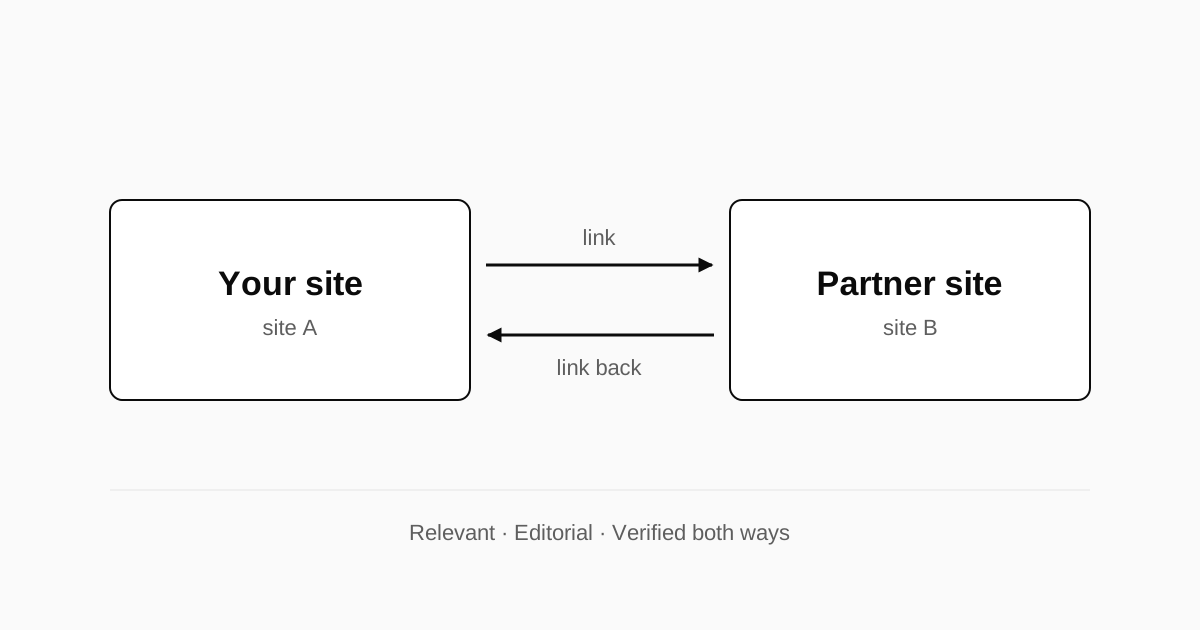
A link exchange is an agreement between two or more site owners to link to each other. It is one of the oldest ideas in SEO and one of the most misunderstood. Some people treat any swap as spam. Others treat it as a shortcut to rankings. Neither view survives a careful read of what Google actually says.
This guide explains how link exchanges work, the formats you will come across, what Google's spam policies say about them, and a practical way to tell a sensible exchange from one that puts your site at risk.
What is a link exchange?
At its simplest, a link exchange is a trade: you place a link to someone else's site, and they place a link to yours. The links usually sit inside content, such as an article, a guide or a resource list, rather than in adverts.
People exchange links for two reasons. The first is the one everybody talks about: links from other sites are one of the signals search engines use to discover and evaluate pages, so a relevant link can help a page get found and ranked. The second is older and more durable: a link from a relevant site sends readers who already care about what you do.
Those two motives matter, because Google's policies turn on which one is really driving the link. A link that exists because it helps readers is a normal part of the web. A link that exists mainly to influence rankings is what Google calls link spam.
The common formats
Direct exchanges (AB)
Site A links to site B, and site B links back to site A. This is the classic reciprocal link. It is easy to agree, easy to check and completely transparent to both parties.
Three-way exchanges (ABC)
Instead of linking straight back, one party gives the return link from a different site they own. Site B links to site A, and the owner of A links to B from a second site, C. No two domains link to each other directly. The trade-offs are covered in detail in ABC vs AB link exchanges.
Content swaps and guest posts
Each party writes an article for the other's site, and each article includes a link back to the author's site. The link is wrapped in real content, which is both its strength and its weakness: a good article is valuable in its own right, but guest posts written mainly to carry links are called out in Google's policies.
Resource and partner pages
A page that lists "partners" or "useful sites", where each listing is there because the other site listed you too. This format was common on the early web, and it is the one most clearly described as a problem today.
What Google's spam policies actually say
Google's spam policies for Google web search define link spam like this:
Link spam is the practice of creating links to or from a site primarily for the purpose of manipulating search rankings.
Among the examples the policy lists, two bear directly on exchanges:
Excessive link exchanges ("Link to me and I'll link to you") or partner pages exclusively for the sake of cross-linking
Using automated programs or services to create links to your site
The wording is doing real work, so it is worth reading slowly.
- "Primarily for the purpose of manipulating search rankings." The test is purpose. Two sites in the same field linking to each other because their readers benefit is not the pattern being described.
- "Excessive." The policy does not say every reciprocal link is spam. It says excessive exchanges are. Google does not publish a threshold, so anyone offering you a "safe number" of swaps is guessing.
- "Exclusively for the sake of cross-linking." Partner pages that exist only to hold swapped links are named outright.
- Automation. Creating links with automated programs or services is listed as link spam. That does not put software off-limits for research or record-keeping, but it does mean a person should decide where links go, and why.
The same page makes one more point worth knowing. It acknowledges that buying and selling links is "a normal part of the economy of the web for advertising and sponsorship purposes", and says:
It's not a violation of our policies to have such links as long as they are qualified with a
rel="nofollow"orrel="sponsored"attribute.
Qualifying a link tells Google not to treat it as an editorial endorsement. That removes the policy problem, and it also removes most of the reason people exchange links for SEO. It is an honest option, not a loophole.
As for consequences: links Google judges to be unnatural can simply be discounted, which means the effort that went into them is wasted. Google can also take manual action against a site, which is reported in the Manual actions report in Google Search Console.
When a link exchange is lower risk
No exchange is risk-free, and nobody can promise that a link will be counted. But some exchanges look like normal web behaviour, because that is exactly what they are.
- The link would make sense without the deal. This is the single best test. If you would happily link to that page because it helps your readers, the exchange is formalising something natural.
- The sites are genuinely related. A bakery equipment supplier and a café management blog share an audience. A bakery equipment supplier and a gambling site do not.
- The link sits in useful content. An editorial mention in a relevant article is very different from a line in a footer, a sidebar or a page of partner links.
- The anchor text reads naturally. Brand names, page titles and ordinary phrases. A run of exact-match commercial anchors is one of the easiest patterns to spot.
- The volume stays modest. A few well-chosen exchanges are a different thing from swapping with everyone who asks. The larger the share of your links that come from exchanges, the more your profile resembles the "excessive" in Google's wording.
- Both sites are real. They publish for an audience, not for search engines. Sites that exist mainly to sell or trade links are where the risk concentrates.
When it becomes risky
The warning signs are mostly the opposite of the list above, plus a few that deserve a mention of their own.
- Link pages and partner directories whose only purpose is to hold swapped links.
- Networks of sites that all link to each other, or to one main site, especially when they share an owner and publish thin content.
- Money changing hands for a link that passes ranking credit. That is a paid link, whatever it is called, and Google expects it to be qualified.
- Irrelevant partners chosen for their metrics rather than their audience.
- Sitewide placements in footers, sidebars and templates.
- Exchanges run at scale by a script, with nobody reading the pages involved.
- Public link-trading lists. Beyond the search risk, some publishers refuse to work with sites they have seen advertised on them, so appearing on one can close doors.
A checklist before you agree to a swap
Run through this before saying yes to any exchange, whether you found the partner yourself or a tool suggested it.
- Open the page where your link would go. Is it a real article that people would read?
- Ask whether you would link to their page if nothing came back. If the answer is no, stop here.
- Check that the page can be crawled and indexed. If it is blocked in robots.txt, Google cannot see the link, and a page kept out of the index with noindex is a poor home for one.
- Look at the other outbound links on the page. Dozens of unrelated commercial links is a red flag.
- Agree the anchor text, the target URL and any
relattribute in writing. - Keep a record of both URLs, the date and what was agreed.
- Verify both links once they are live, and keep checking. Links get removed, pages get redirected, and a noindex tag can appear months later.
Where tools fit in, and what they cannot do
The slow parts of a link exchange are finding partners who are genuinely relevant, agreeing terms, and making sure both sides keep their word. Software is good at all three. What software cannot do is change the purpose of a link. Moving a swap into a tool, or into an AI assistant, does not make an excessive exchange acceptable.
That is the thinking behind how B.E.N works. You add your websites and the criteria a link has to meet. You connect the AI you already use, such as Claude, Cursor, Gemini, GitHub Copilot or Windsurf, to B.E.N over MCP. Your AI finds placements that fit those criteria and sets up the exchange, and you approve the deal. A crawler then checks every link in the deal: the one you get and the one you give. For a step-by-step look at that workflow, read how to find backlink opportunities with an AI assistant and MCP.
The short answer
Link exchanges are not automatically spam, and they are not a ranking shortcut. A small number of exchanges between genuinely related sites, placed in useful content and verified over time, look like the normal web. Excessive swaps, partner pages, irrelevant partners and links placed only for rankings are what Google's policies describe, and no format or tool changes that.
If you want your AI to do the searching and the checking while you keep the decisions, get started with B.E.N.