ABC vs AB link exchanges: three-way and direct link swaps explained
How direct (AB) and three-way (ABC) link exchanges work, why people choose three-way swaps, and the real risks and trade-offs of each format.
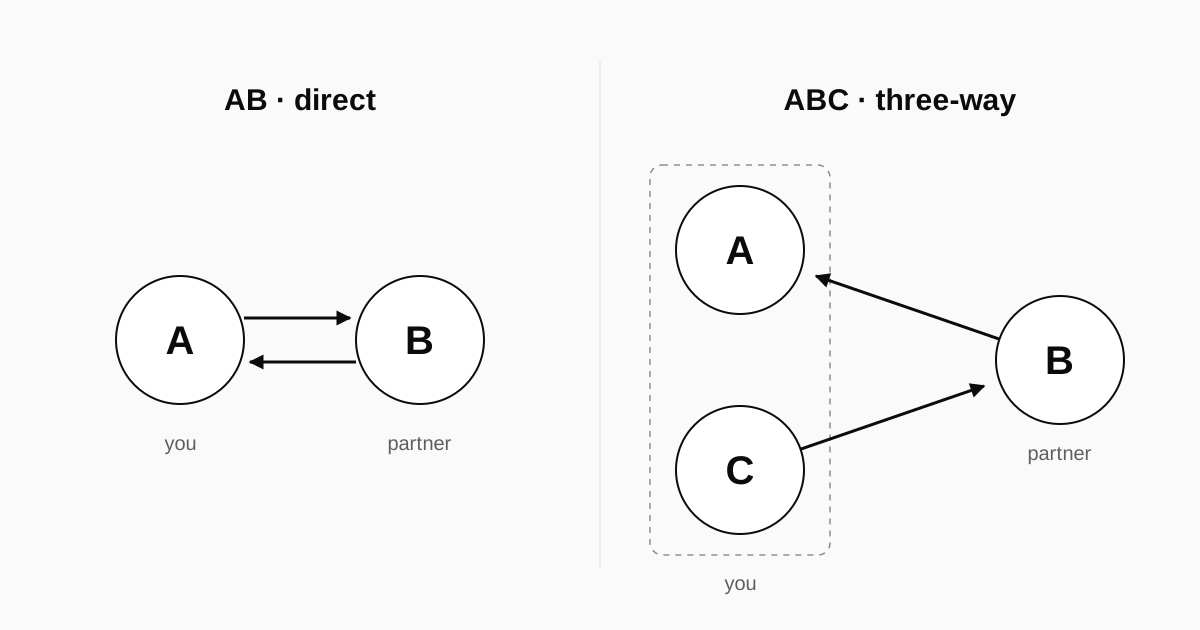
If you have spent any time around link building, you have seen offers of "ABC links" or "three-way link exchanges", usually presented as a safer alternative to swapping links directly. The idea behind them is simple. The claims made for them often are not.
This guide explains how direct (AB) and three-way (ABC) exchanges work, why people use each one, what the formats do and do not change, and how to decide between them.
The short version
| Direct exchange (AB) | Three-way exchange (ABC) | |
|---|---|---|
| Structure | Site A links to site B, and B links back to A | B links to A; the owner of A links to B from another site, C |
| Sites involved | Two | Three, sometimes more |
| Reciprocity | Visible: the two domains link to each other | Indirect: no pair of domains links both ways |
| Coordination | Simple | More parties and pages to agree and check |
| Main risk | An obvious pattern when repeated at scale | The quality and purpose of site C |
| Changes the purpose of the links? | No | No |
How a direct (AB) exchange works
Two site owners agree to link to each other. Site A publishes a link to a page on site B, and site B publishes a link to a page on site A. Both links usually sit in relevant content, such as a guide or a resource list.
A direct exchange has a lot going for it:
- It is transparent. Both parties can see exactly what they are giving and getting.
- It is easy to verify. There are two links on two pages, and either party can check both.
- It suits genuinely related sites, which is also when it is easiest to defend: two businesses serving the same audience often have good reason to point readers at each other.
Its weakness is the same transparency. One reciprocal link between related sites is unremarkable. A link profile in which a large share of links are mirrored by a link straight back is a recognisable pattern, and it is the one Google's spam policies describe as "excessive link exchanges ("Link to me and I'll link to you")".
How a three-way (ABC) exchange works
In a three-way exchange, the return link comes from a different site. The most common arrangement involves two parties and three sites:
- You own site A, the site you want a link to, and a second site, C.
- Your partner owns site B.
- Site B links to site A.
- In return, site C links to site B.
Site A gets its link, your partner gets theirs, and no two domains link to each other directly. A variation spreads the deal across three owners, each giving a link to the next in a loop, so that A links to B, B links to C and C links to A.
Why people choose ABC
There are a few reasonable motives, and one that does not hold up.
Your most relevant content is on another site. If you run two sites, and the one that suits your partner's audience is not the one they want a link to, giving the link from the better-matched site can simply be the better editorial fit.
You want to limit outbound links from one site. Some owners prefer to keep their main site's outbound links to a minimum and are happy to link from a related site instead.
To make the exchange less visible. This is the reason most often given in sales pitches, and it is the weakest of the three.
Does ABC hide an exchange from Google?
Nobody outside Google can tell you what its systems can or cannot detect, so any promise that a format is "undetectable" is unverifiable at best. More importantly, the question misreads the policy. Google defines link spam by purpose:
Link spam is the practice of creating links to or from a site primarily for the purpose of manipulating search rankings.
Moving the return link to another domain changes the shape of an arrangement, not its purpose. If an AB swap would be a link scheme, the same deal routed through site C is still one. And if an AB swap between two relevant sites would be fine, ABC adds complexity without adding safety.
So the useful question is not "which format is safer?" but "would these links make sense to readers, whatever the format?" The signals that answer it are the same either way, and they are covered in when a link exchange is lower risk.
Risks specific to three-way exchanges
ABC does bring some risks of its own.
- The quality of site C. The third site is often a secondary property. Sometimes it is a genuine site with its own readers. Sometimes it exists mainly to hand out links, and a link from a thin site built for linking is worth little and belongs to the kind of network Google's policies describe.
- Relevance drift. Your partner agreed to link to site A because of A's content. Site C may be far less relevant to their site than A would have been, which weakens the link they receive and makes the deal harder to justify.
- Harder verification. More sites and pages mean more to check, and more ways for one leg of the deal to disappear quietly.
- Uneven trust. With more moving parts and less visibility, it is easier for one side to deliver late, deliver less, or remove a link later.
- Ownership. You are trusting that site C is really controlled by the person offering it. That is worth confirming before you agree.
Risks specific to direct exchanges
- Visible reciprocity at scale. A few exchanges between related sites look normal. A consistent pattern of mirrored links does not.
- Drift towards link pages. Direct exchanges tend to end up on "partners" or "resources" pages that exist to hold swapped links, which Google's policy names specifically.
- Weak partners accepted for convenience. The ease of AB makes it tempting to say yes to anyone who asks.
How to choose
Start from the links, not the format.
- Would each link make sense to a reader without the deal? If not, neither format fixes that.
- Are the two sites genuinely related? If so, a direct exchange is the simplest and most transparent option.
- Does your best page for this partner live on a different site you own? Then a three-way exchange can be the better editorial fit, as long as that site is real and publishes for an audience.
- Is site C only there to give links? Then do not use it.
- Can every link in the deal be verified, now and later? If you cannot check a leg of the deal, do not rely on it.
Verifying any exchange
Whatever the format, check each link when it goes live, and keep checking:
- The link is present on the agreed page and points at the agreed URL.
- The anchor text and any
relattribute match what was agreed. - The page returns a normal response and has not been redirected elsewhere.
- The page is not set to noindex and is not blocked by robots.txt.
- The page's canonical tag points to the page itself rather than to another URL.
Doing this by hand across more than a few deals quickly turns into a spreadsheet problem. In B.E.N, a crawler checks the link you get and the link you give in every deal, and keeps checking, so a link that comes down does not go unnoticed. Your AI finds partners that match the criteria you set and sets up the deals over MCP, and you approve them. For a walkthrough of that approach, see how to find backlink opportunities with an AI assistant and MCP.
The bottom line
AB and ABC exchanges differ in shape, not in principle. A direct exchange between related sites is simple and transparent. A three-way exchange can make sense when your best-fit content lives on another site you run, and becomes a liability when the third site exists only to give links. Neither format makes a link built purely for rankings acceptable, and neither needs to, if every link in the deal is one you would be comfortable explaining.
Get started with B.E.N to find relevant partners and verify every link in the deal.